
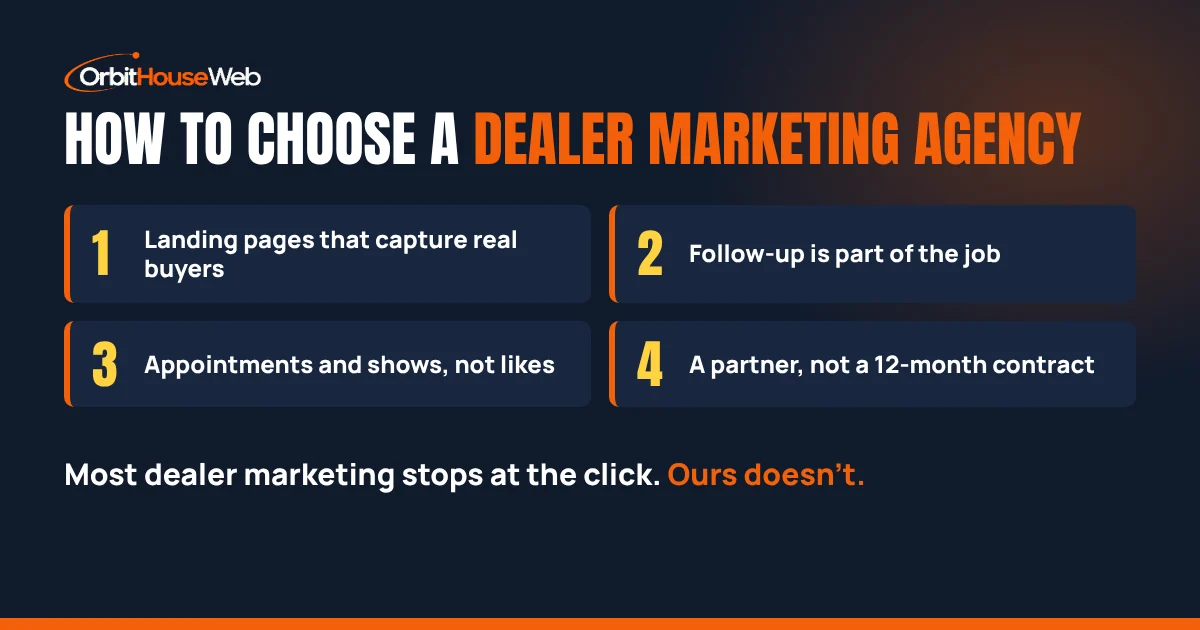
How to Choose the Best Car Dealer Marketing Agency (and What We Do Differently)
7 questions to ask before you hire a dealer marketing agency, and the four things we do that most agencies don't.
Read the guideResources/Guide
Most dealer marketing advice stops at the click. This guide follows one lead from the ad to the showroom, and shows where deals get lost.
Search "car dealer marketing" and you get the same list over and over. Post on social. Get reviews. Try video. Run email. None of it is wrong, but none of it tells you where deals actually get lost.
Here's what we see. Dealers usually don't have a lead problem. They have a gap between the lead and the showroom. The ad works, the form fills, and then the lead sits in an inbox overnight or gets one call and a voicemail.
So this guide follows one path instead of ten tactics: the ad, the form, the first response, the follow-up, and the appointment that actually shows. Fix each step and the same ad budget sells more cars.
Every lead takes the same five steps. Most dealers only measure the first one.
Your next customer is scrolling Facebook and Instagram tonight. Social media campaigns let you put real inventory in front of people near your store, then ask them to raise their hand.
What makes a dealer campaign work:
This works for new and used dealers alike. The inventory changes. The path from ad to appointment doesn't.
Every strong dealer ad has the same five parts. Miss one and the ad still runs, it just gets fewer leads for the same money.
These are the ones we see most often:
You have two options, and each one has a job.
| Instant form | Landing page | |
|---|---|---|
| Where it lives | Inside Facebook or Instagram | On your own site |
| Strength | More leads, very little friction | Better leads, more intent |
| Weakness | Some people fill it out without thinking | Fewer people finish |
| Best for | Broad offers, trade-in values | Specific vehicles, financing |
A good campaign often uses both. Either way, keep the form short: name, phone, and one question that tells your team what the buyer wants. A form that asks for ten things gets abandoned.
We cover this in more detail in Instant forms vs. landing pages.
A lead is never hotter than the minute it comes in. That buyer just raised their hand, and they probably raised it at two other stores too.
And plenty of dealers still miss it. Pied Piper's 2026 study sent web inquiries to 3,290 dealerships and tracked what happened over the next 24 hours:
14% of dealerships never personally responded. Only 62% of dealerships answered with both a phone call and an email or text. Pied Piper says dealers who move from its lowest scores to its highest sell 50% more units from the same internet leads. (AutoSuccess, 2026)
Where dealers lose the first hour:
The fix is simple to say and hard to do: every lead gets an owner, a fast reply, and a reply about the car they asked about. More in Speed to lead: why the first hour decides the deal.
One call and a voicemail is not follow-up. Most buyers don't answer an unknown number on the first try. Plenty never answer at all, but they will read a text.
A simple first week that works for most stores:
Keep every message short and about their car. If it reads like a mass email, it gets ignored like one.
Automation alone doesn't fix it either. In the same 2026 study, when a dealer's automated tools couldn't answer and the customer needed a person, those dealers scored 9 points lower and the customer was twice as likely to get no personal reply at all.
This is the step that falls apart when the floor gets busy. It's why we built Blast Off: our AI assistant, Cosmos, drafts each follow-up, and someone on your team approves it before it goes out. Read the launch announcement.
A booked appointment isn't a sale. It isn't even a visit until the buyer walks in.
Small habits that move show rate:
When someone no-shows, treat them like a fresh lead the same day. They were interested enough to book.
Most dealers track lead count and cost per lead. Those tell you the ads are working. They don't tell you what happens next.
| Number | What it tells you | Where to fix it |
|---|---|---|
| Cost per lead | Are the ads reaching the right people? | Step 1 |
| Form completion | Is the form too long or confusing? | Step 2 |
| Speed to lead | How long leads wait for a real reply | Step 3 |
| Contact rate | How many leads you actually talk to | Step 4 |
| Appointment rate | How many conversations turn into a visit | Step 4 |
| Show rate | How many appointments walk in | Step 5 |
| Cost per sale | What a sold car really cost in marketing | All of it |
If your cost per lead looks great but cost per sale doesn't, the problem isn't the ads. Look further down the list.
You shouldn't need a spreadsheet to see these. In Blast Off, they're the first thing your team sees every morning: new leads, conversations, appointments, and sales, with contact rate, appointment rate, show rate, close rate, and speed to lead underneath.
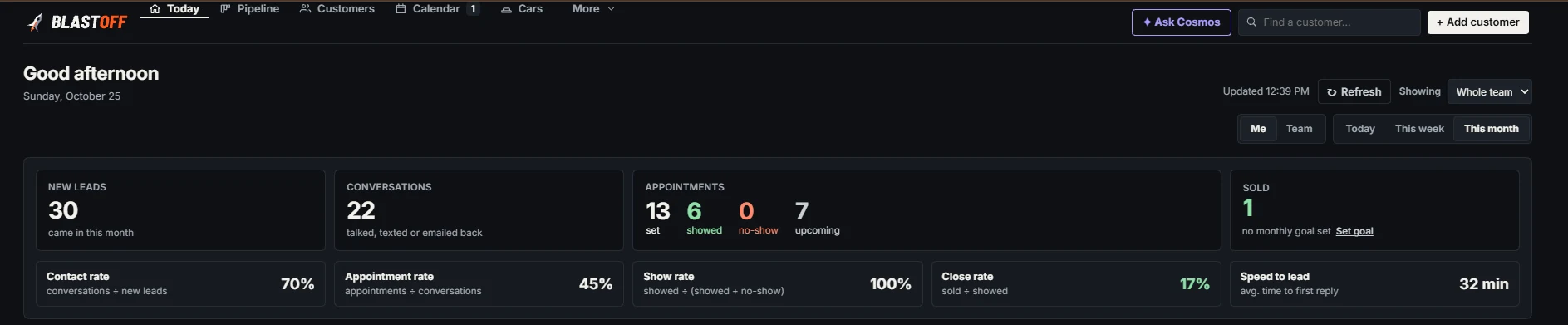
These numbers are made up to show the math. They are not results from a real store.
Say a dealer spends $3,000 a month on social media campaigns and gets 100 leads. That's $30 a lead, which looks good on a report.
| Before | After fixing follow-up | |
|---|---|---|
| Leads | 100 | 100 |
| Leads contacted | 50 | 80 |
| Appointments set | 20 | 32 |
| Appointments that show | 10 | 22 |
| Cars sold | 5 | 11 |
| Marketing cost per car sold | $600 | about $273 |
Same ads, same budget, same leads. The only changes are how fast the team replies, how long it follows up, and whether it confirms appointments. That's where most of the money in car dealer marketing is hiding.
We're a dealer marketing partner. We handle the whole path in this guide, from the ad to the appointment, so leads don't get lost between the agency and the sales floor.
We work with new and used car dealers across the country.
Everything a dealership does to bring in buyers: ads, social media, its website, reviews, and email. The part that pays off is turning that attention into appointments and sales.
The best channel is the one you can follow up on. Social media campaigns are great at reaching local buyers, but they only pay off if leads get a fast reply and steady follow-up.
Yes. The same path applies: real inventory in the ad, a short form, a fast reply, and follow-up until the buyer comes in.
As fast as you can, by phone and by text or email. In Pied Piper's 2026 study, dealers for the top brands reached more than half of web leads both ways within 15 minutes.
At least a week of active follow-up. After that, keep the buyer on a slower schedule until they buy or say no.
Yes, when it runs as an ongoing campaign with real inventory and a team that follows up. It's not worth much if the leads sit in an inbox.
We run social media campaigns for new and used car dealers, build the landing pages and lead forms behind them, and send leads straight to the sales team. Our follow-up system, Blast Off, helps dealers reply fast and track speed to lead and show rate.
7 questions to ask before you hire a dealer marketing agency, and the four things we do that most agencies don't.
Read the guide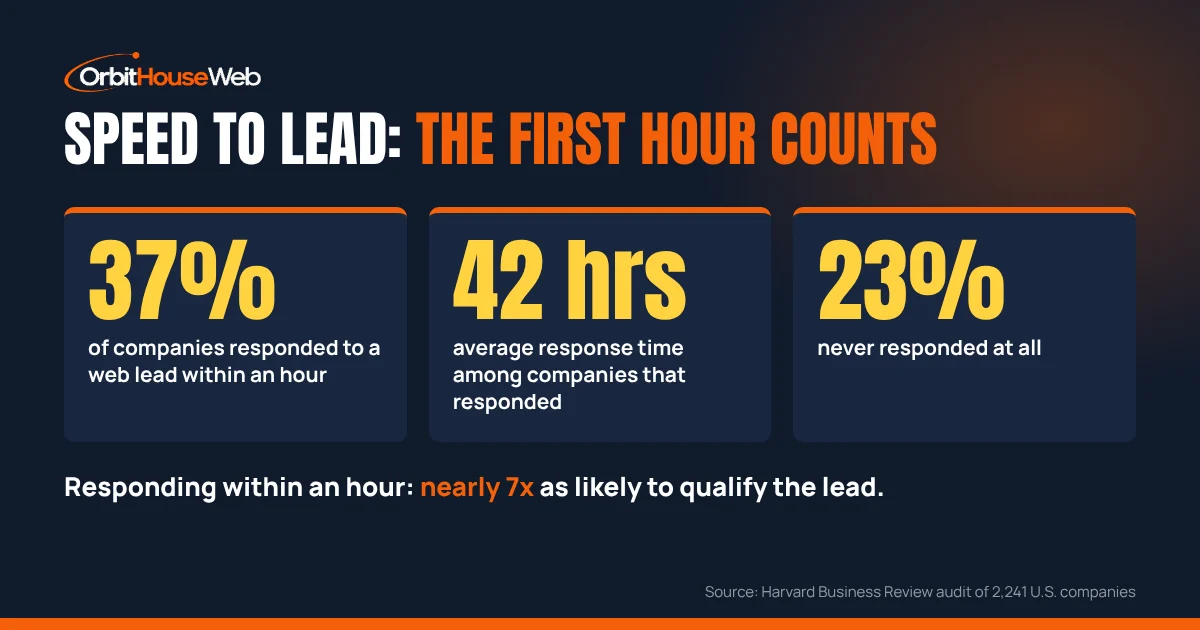
The lead is never hotter than the minute it comes in. What the research says and how dealers can respond faster.
Read the guideTell us what's on your lot and what you want to move, and we'll show you how we'd set it up.
We use cookies to see how visitors use this site. Privacy Policy